
Why Luxury Brands Need a Different Marketing Strategy Than Premium Brands
Beyond-luxury clients, those spending more than fifty thousand euros a year, make up under one per cent of all luxury consumers. They account for twenty one per cent of total luxury spend, roughly two hundred times the average client, and that share has doubled over the past decade according to Bain and Altagamma’s research. No strategy built for volume will ever reach that client. It was never designed to. That is the argument this piece makes, and it is not a hedge: luxury and premium are different disciplines, not different price points on the same one.

The Category Error at the Centre of Most Luxury Marketing
Most luxury marketing underperforms for one reason: it is premium marketing wearing luxury language. Reach where there should be restriction. Conversion rate where there should be margin per client. The tactics are not wrong, they are simply built for a different category entirely.
At Giant Leap, this is the first thing we audit with a new client, before touching a single channel. Fixing the category error is a strategy problem before it is a tactics problem.
Premium Competes Within a Category. Luxury Constructs One.
A premium car is still, unmistakably, a car, better materials, a stronger badge, priced above mainstream but still comparable to it. A luxury house is not trying to be the best version of a category. It is constructing a category of one, where comparison is the wrong frame from the start.
A collector does not judge a minute repeater against other watches. They judge it against the idea of permanence itself. Get this distinction wrong and every downstream decision, targeting, creative, pricing, inherits the error.
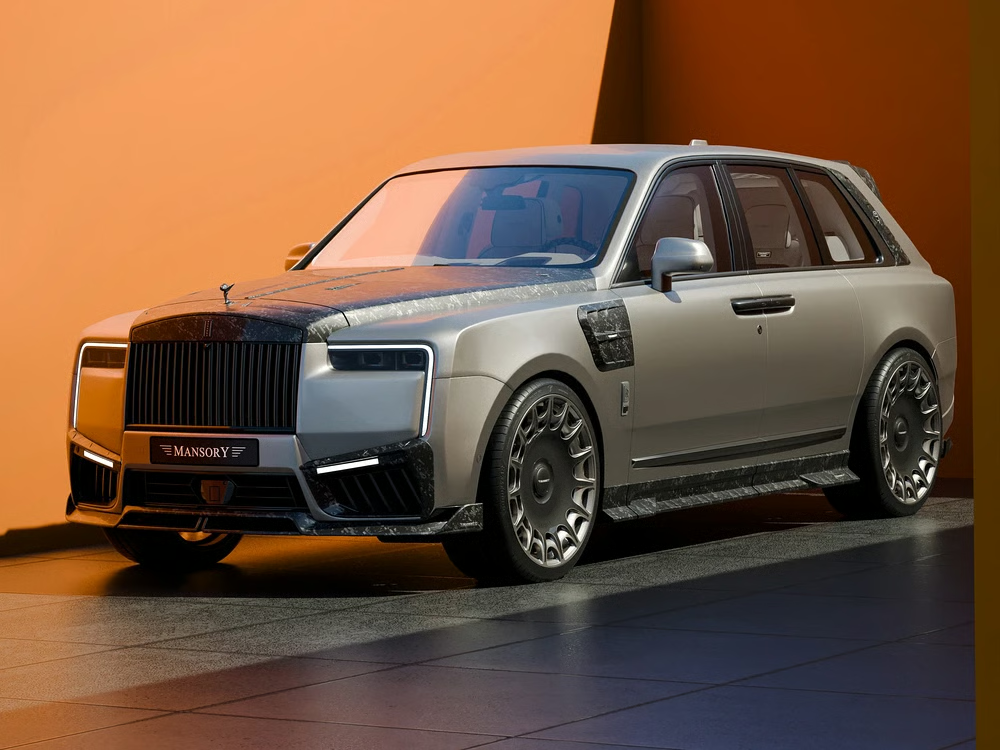
Two Numbers Every Luxury CMO Should Know
- 50% of luxury consumers now use AI tools somewhere in their purchase journey.
- Two in three of them use it specifically to compare options before committing.
That is the entire discovery brief for 2026 in two figures. A brand with thin, generic, keyword-stuffed content will not surface in that comparison. Premium brands, built to compete on features and price, are suited to exactly this kind of evaluation. Luxury brands are not, and should stop trying to be.

Premium Strategy Versus Luxury Strategy
| Dimension | Premium strategy | Luxury strategy |
| Core objective | Maximise reach and conversion volume | Protect scarcity and deepen desire |
| Pricing logic | Priced above mainstream, still comparable | Priced outside comparison entirely |
| Audience approach | Broad targeting within an affluent segment | Narrow targeting toward the culturally influential few |
| Growth metric | Market share and unit volume | Margin per client and lifetime relationship value |
| Discovery in 2026 | Paid reach and comparison shopping | Editorial authority, referral, AI-mediated citation |
Where This Actually Plays Out
Van Cleef & Arpels is not selling a piece of jewellery, it is managing a client relationship that can span decades before a high jewellery acquisition happens at all. The Macallan builds scarcity by design through fixed annual releases, and older cask prices have appreciated well beyond inflation because supply cannot expand to meet demand. Huntsman on Savile Row rarely finds a client through a funnel, the client is found through who they already know. Bentley’s configurator frames specification as a craftsmanship story, not a checkbox list, and Krug’s Krug ID lets a client trace the exact blend behind their bottle rather than rushing them to checkout. Every one of these rewards depth over reach.
The clearest sign a brand is running a premium strategy in a luxury wrapper is when the marketing team celebrates a spike in traffic. Luxury clients were never meant to arrive in spikes.
Hannah Blunt, Luxury Account Strategist at Giant Leap Digital

The Scarcity Audit: A Model to Apply Directly
Before committing budget to any luxury campaign, run it against four questions.
- Does this increase or reduce perceived scarcity. If it makes the brand feel more available, it belongs in a premium strategy.
- Does this speak to the few who influence the many, or the many who influence no one. Reach without cultural weight is wasted spend.
- Does this deepen a relationship or record a transaction. Luxury marketing succeeds at stewardship, not checkout.
- Would removing this make the brand more desirable by its absence. If restriction would improve standing, the current approach is working against itself.

The Client Journey Luxury Marketers Actually Need
Premium funnels maximise volume at every stage. Luxury journeys filter, so only the right client progresses at all.
- Discovery through cultural placement and referral, not paid reach, increasingly mediated by AI comparison rather than a page of search results.
- Qualification on genuine fit, not income proxy alone, which a spend threshold cannot measure.
- Cultivation over months or years through private access, not open-funnel nurture sequences.
- Acquisition as the smallest part of the journey by time and strategic weight, not the goal it is treated as.
- Stewardship that determines whether this client refers the next one, which is where luxury marketing actually wins or loses.
We mapped a version of this filtering logic for guests specifically in How Luxury Hotels Increase Direct Bookings Without Discounting. The same discipline applies to any luxury client relationship, not only a booking engine.

Why 2026 Raises the Stakes
The luxury market is polarising, not shrinking. Bain’s 2026 data shows the high-end tier gaining share in hospitality, fine wine and spirits, and fine dining, the categories built on relationship, while leather goods and footwear absorb a real contraction. Brands blurring premium and luxury positioning are, structurally, choosing to compete in the tier that is contracting.
Key Takeaways
- Luxury is a distinct structure of desire, not a higher price point, and treating it as one produces measurable margin loss.
- Beyond-luxury clients are under one per cent of the base but a fifth of total spend, making relationship depth the primary lever, not acquisition volume.
- Half of luxury consumers now use AI in their purchase journey, rewarding editorial authority over templated content.
- Run a quarterly scarcity audit before any campaign, channel, or content decision.

Written by Sophia Evgeniou, Chief Marketing & Growth Officer
Giant Leap Digital is a Mayfair-based luxury digital marketing agency working with luxury hospitality, fashion, automotive and premium wine and spirits on strategy that treats luxury as its own discipline, not a pricier version of premium.
FAQ
What is the main difference between luxury marketing and premium marketing.
Premium marketing maximises reach and conversion within a comparable category. Luxury marketing restricts availability and deepens desire outside comparison, prioritising margin per client over volume.
Why do luxury brands avoid broad-reach advertising.
Desirability in luxury is partly constructed through restricted access. Broad reach signals availability, which reads as a decline in exclusivity rather than growth.
What is the Kapferer and Bastien anti-laws framework.
A model from luxury strategy academics Jean-Noël Kapferer and Vincent Bastien, arguing luxury brands must reverse conventional marketing logic on demand, communication, and growth to protect brand equity.
Can a luxury brand use performance marketing at all.
Yes, structured around precision and narrow qualification, targeting the culturally influential few rather than optimising for lowest cost per click.
How should a luxury brand measure success differently in 2026.
Through margin per client, referral quality, relationship depth, and AI-mediated discovery visibility, rather than conversion rate or raw traffic growth
- SEO for Luxury Brands: Why Rankings No Longer Tell the Full Story
- What Makes Paid Media Feel Luxury Instead of Promotional? A Guide for Premium Brands
- Why Your Luxury Brand Isn’t Generating Enough Qualified Leads
- Luxury SEO in 2026: Why Rankings Don’t Equal Revenue
- Luxury Copywriting for HNW Clients: How to Write Copy That Converts

