
There is a prevailing assumption in digital marketing that growth and prestige are fundamentally in tension. Scale the media spend, the thinking goes, and you inevitably dilute the mystique. Reach more people and you risk reaching the wrong ones. This is treated as a law of luxury. It is not. It is a failure of strategic discipline.
The brands that have grown most intelligently in the past decade Bottega Veneta under Daniel Lee, Loro Piana since LVMH’s acquisition, Porsche across its global paid media expansion did not sacrifice desirability at the altar of reach. They scaled with intention. The question is not whether to invest in paid media at scale. The question is how to do it without the brand losing the thing that made it worth buying in the first place.

The core tension is real, even if the fatalism around it is not. Luxury value is, in part, a function of perceived scarcity and social distance. French sociologist Pierre Bourdieu’s concept of distinction, the idea that luxury consumption is fundamentally about differentiation from those with less cultural and economic capital, remains the most useful framework here. When paid media is deployed without discrimination, it collapses that distance. The brand appears everywhere. It speaks to everyone. And in doing so, it speaks meaningfully to no one. The answer is not restraint in budget. It is precision in architecture.
What that means in practice begins with audience stratification. The single greatest mistake luxury brands make when scaling paid media is treating their audience as a single tier. Affluent, wealthy, HNW, and UHNW consumers do not respond to the same creative, the same channels, or the same frequency. A £50,000 watch buyer on Instagram is not motivated by the same signals as a £500,000 watch buyer being reached through private programmatic inventory. Treating them identically which most scaled campaigns do, because it is easier results in messaging that feels neither exclusive nor relevant to either group.
Effective scaling requires distinct creative hierarchies for distinct audience segments, with paid channels selected for their ability to signal exclusivity rather than maximise volume. Programmatic display, when placed on premium publisher environments Condé Nast, the Financial Times, Bloomberg carries contextual authority that a Meta broad-audience campaign simply cannot replicate, regardless of how good the creative is. The placement is part of the message.

Creative consistency under pressure is the second failure point. When brands scale paid media quickly, creative production becomes a bottleneck. The response is almost always to lower the creative bar: shorter briefing cycles, repurposed assets, formats optimised for clicks rather than brand perception. The result is that the paid media layer of the brand starts to look different cheaper, more transactional than the owned and earned layer. Consumers notice this incoherence, even when they cannot articulate it. Trust erodes quietly.
Porsche navigated this well during its expansion into paid social markets in Asia. Rather than adapting its creative to platform norms — the high-energy, fast-cut formats native to those environments the brand maintained its visual language and introduced platform-native elements only at the margins. The result was paid content that felt unmistakably Porsche on channels where that required active discipline. The brand did not conform to the platform’s aesthetic gravity. It resisted it, intelligently.
Burberry’s misstep under the mid-2010s digital expansion remains instructive in the opposite direction. The brand moved aggressively into social advertising, broadened its product range, and scaled media spend significantly. The accessibility of the messaging attracted the wrong audiences at volume, triggered a counterfeiting surge, and critically signalled to existing customers that the brand had compromised its own selectivity. Recovery required years of deliberate brand repositioning under new creative direction. The damage was not caused by spending money on paid media. It was caused by spending it without an audience architecture that protected the brand’s social meaning.

Frequency is the silent brand killer that most performance frameworks ignore. In a pure direct-response context, frequency is managed to prevent creative fatigue. In luxury, the stakes are different. Seeing the same brand advertisement repeatedly, in multiple contexts, signals availability rather than aspiration. It suggests the brand is trying. Luxury brands should not appear to be trying. The optimal frequency for HNW and UHNW audiences in paid media is meaningfully lower than platform algorithms will recommend, because those algorithms are calibrated for conversion volume, not brand perception. Overriding them requires deliberate campaign architecture and a willingness to sacrifice short-term efficiency metrics.
The data infrastructure required to do this well is not optional at scale. First-party data properly enriched and segmented allows brands to identify not just who their customers are, but which prospects share the behavioural and contextual signals that predict high-value intent. Digital footprint modelling, when applied rigorously, means a luxury automotive brand does not need to serve paid media to everyone who has shown interest in cars. It can identify the narrower set of individuals whose broader online behaviour, the publications they read, the financial products they research, the events they show intent around places them credibly within the purchasing universe. That is the difference between reach and relevant reach.
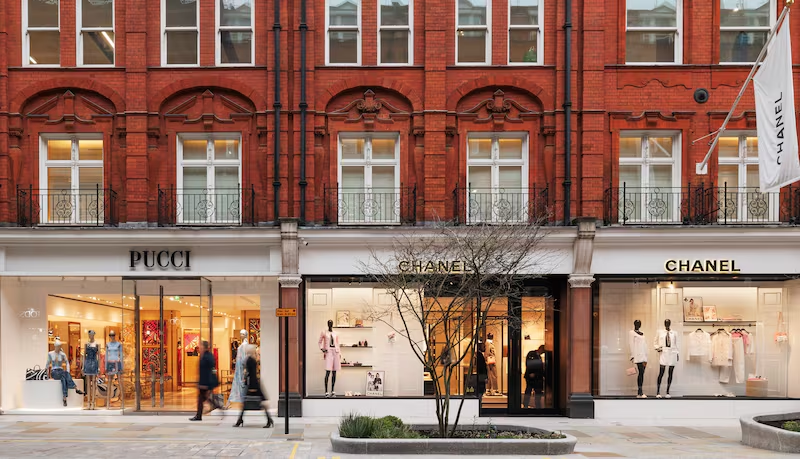
There is also a channel timing question that rarely gets the attention it deserves. Paid search at scale, for luxury brands, carries a specific risk: it makes the brand visible at a point of active demand, which sounds like a virtue but is not always one. Luxury brands with strong desirability do not need to intercept demand. They need to precede it by building the association, the aspiration, the sense of inevitability so that when the purchase moment arrives, the brand is the obvious answer rather than a search result. Investment in programmatic brand-building, in premium video, in digital out-of-home in high-value urban environments, does work that paid search cannot. A Mayfair digital billboard during the right week, targeting the right postcodes, reaches fewer people than a scaled Meta campaign but reaches them in a context that reinforces value rather than commoditising it.
None of this suggests luxury brands should be precious about paid media investment. The global personal luxury goods market was valued at approximately €362 billion in 2023 according to Bain & Company’s annual luxury study, and the brands growing within it are not doing so through restraint alone. They are doing so through the kind of structural intelligence that separates paid media that builds brands from paid media that merely generates transactions.
The distinction is this: performance marketing that serves the brand must be held to brand standards, not just performance standards. That requires senior marketing leadership to remain actively involved in paid media governance not delegating it entirely to performance teams optimising toward cost-per-acquisition. It requires creative briefs that treat paid assets as brand assets, not conversion tools. And it requires a willingness to measure success on brand equity metrics aided awareness, consideration among defined HNW segments, share of search in premium categories alongside, and sometimes in preference to, ROAS.
Scaled paid media, done right, does not dilute luxury. It extends the brand’s reach into new audiences without lowering the quality of the relationship. It finds the right people before they are actively looking. It positions the brand in environments that reinforce its value. And it protects the social meaning of the product by ensuring that at no point does the advertising make ownership feel ordinary.
That is not a contradiction of luxury marketing principles. It is their most demanding application.

Written by, Inga Timanova
Head of Paid Media
- SEO for Luxury Brands: Why Rankings No Longer Tell the Full Story
- What Makes Paid Media Feel Luxury Instead of Promotional? A Guide for Premium Brands
- Why Your Luxury Brand Isn’t Generating Enough Qualified Leads
- Luxury SEO in 2026: Why Rankings Don’t Equal Revenue
- Luxury Copywriting for HNW Clients: How to Write Copy That Converts

